Innovation has a reputation as something close to magic — a lightning bolt of inspiration that either strikes or it doesn’t. McKinsey spent years arguing the opposite. In its widely cited article “The Eight Essentials of Innovation” (McKinsey Quarterly, by Marc de Jong, Nathan Marston, and Erik Roth, April 2015, refreshed January 2024), the firm makes the case that innovation is far less about luck and far more about discipline: a repeatable system that well-run companies build on purpose.
The evidence is hard to ignore. McKinsey’s study drew on interviews, workshops, and surveys of more than 2,500 executives across 300-plus companies, and found that innovation leaders generate almost twice as much revenue growth from innovation as their competitors. A 2023 update added a sharper edge for the AI era: among the strongest innovators surveyed, 30% were already deploying generative AI at scale in their innovation and R&D functions — more than six times the rate of companies lagging on innovation.
In other words, the companies that already know how to innovate are the ones pulling ahead with AI. That’s a pattern worth understanding. Here’s a summary of McKinsey’s eight essentials, followed by how we read them at Evio Group.
What McKinsey found
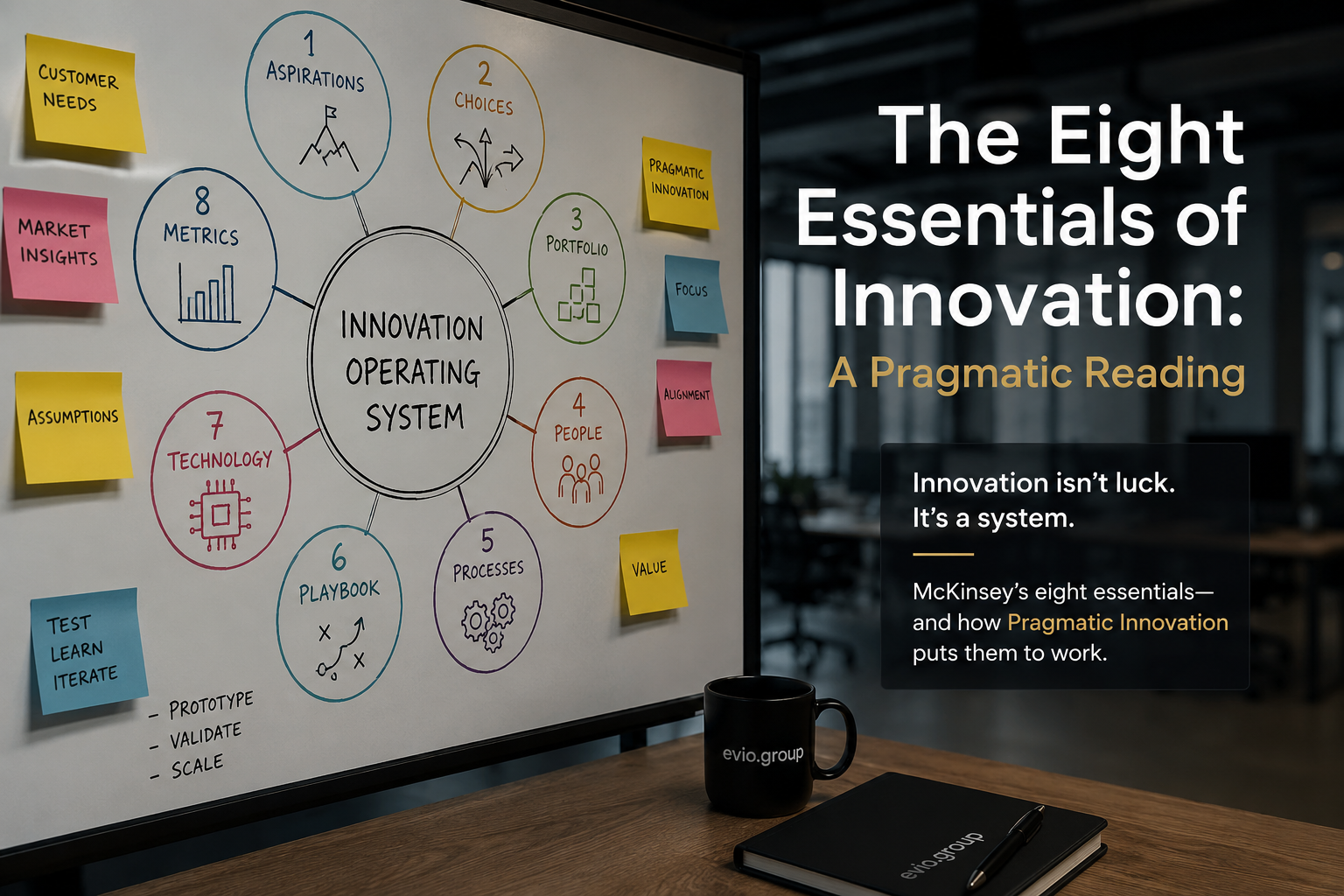
McKinsey frames the eight essentials as an “operating system” for innovation. The first four are strategic and creative — they set the conditions under which innovation can thrive. The next four are about execution and organization — how you deliver innovation repeatedly, at a scale that actually moves the business.
The strategic four:
- Aspire. Treat innovation as a top priority with a real number attached. McKinsey points to Lantmännen, a Nordic agricultural cooperative that set explicit growth targets (6% in the core, 2% from new ventures), cascaded them down to product groups, and went from 4% to 13% annual growth.
- Choose. Fund more ideas than you can ultimately back, then manage the portfolio like an investor — killing the weak ones early. RELX Group runs 10–15 small experiments per customer segment each year and scales only one or two.
- Discover. Find insight where three things intersect: a valuable problem, an enabling technology, and a business model that makes money from solving it. That intersection is where durable innovation tends to live.
- Evolve. Reinvent your business model before a disruptor does it for you. McKinsey cites the Financial Times, which moved from print-advertising dependence to digital subscriptions ahead of the curve.
The execution four:
- Accelerate. Beat your own bureaucracy. McKinsey describes the “antibodies” — legal, IT, and process gatekeepers — that quietly kill good ideas, and argues for empowered, genuinely cross-functional teams that test with customers early.
- Scale. Match an idea’s resources and rollout to its real market size. Scaling up slowly “to be safe” can be a death sentence; TomTom’s rapid rollout is the counter-example.
- Extend. Innovate through partners and ecosystems. Apple sourced most of the first iPod’s components externally and shipped in nine months; NASA’s Ames Research Center partners with everyone from foreign governments to SpaceX.
- Mobilize. Bake innovation into the culture through incentives and accountability. At Discovery Group, innovation is a standing measure on divisional scorecards — its leaders, as the founder puts it, have no choice but to innovate every year.
The takeaway from McKinsey is that these practices reinforce one another. Do one or two well and you get incremental results; build the whole system and innovation becomes repeatable.
The Evio Group take: this is Pragmatic Innovation
We’ve read a lot of innovation frameworks. The reason this one has lasted a decade is that it’s honest about the hard part — innovation fails less from a shortage of ideas than from a failure to choose, fund, and finish them. That’s exactly the conviction behind Pragmatic Innovation, our approach to helping technology companies and the investors who back them turn ideas into measurable results.
Here’s where our experience sharpens McKinsey’s framework.
Start with the problem, not the tool. McKinsey’s “Discover” essential lands at the intersection of problem, technology, and business model. We’d put even more weight on the problem. The most expensive mistake we see — especially right now with AI — is the tool-first trap: adopting a technology because it’s fashionable rather than because it solves a defined, valuable problem. Pragmatic Innovation starts by naming the problem clearly enough that you can tell whether any solution actually worked.
Prototype before you promise; validate before you scale. McKinsey’s “Choose,” “Accelerate,” and “Scale” essentials all point the same direction: run more small experiments, get feedback early, and only pour resources into what’s proven. We build that discipline into every engagement. A prototype that disproves an idea in three weeks is worth more than a strategy deck that defends it for three quarters.
Measure innovation against outcomes you can take to the board. “Aspire” and “Mobilize” both hinge on attaching real numbers to innovation. We agree, and we hold ourselves to it. Across recent engagements, that discipline has produced a 40% uplift in operational efficiency, a 25% reduction in prototype costs, and a 50% reduction in installation time. Different problems, same pattern: a defined path, disciplined execution, and results you can measure.
The AI dimension makes the essentials more urgent, not less. The reason innovative companies are winning with AI isn’t better technology — it’s that they already have the operating system to absorb it. They know how to choose where AI is worth deploying, how to prototype it safely, how to scale what works, and how to bring their people along. For technology companies weighing where AI and security fit into the roadmap, the lesson is clear: the framework comes first. The tools plug into it.
Meet the company where it is. McKinsey’s examples are global giants — Amazon, Apple, NASA. Most organizations aren’t NASA, and they don’t need to be. The value of the eight essentials isn’t in copying Apple; it’s in adapting the underlying discipline to your context, capabilities, and appetite for risk. That translation — from a big-company framework to a pragmatic plan a real team can execute — is the work we do.
From framework to action
If you want to put the eight essentials to work without boiling the ocean, start small and concrete: pick one valuable problem, attach a number to what solving it is worth, run a cheap experiment to test the most uncertain assumption, and decide in advance what result would make you scale it — or kill it. That single loop contains most of McKinsey’s framework in miniature, and it’s where Pragmatic Innovation begins.
Innovation isn’t magic. It’s a system you can build, and a discipline you can learn. If you’d like help putting it to work in your organization — including figuring out where AI genuinely belongs in your roadmap — that’s exactly the conversation we’re built for.
For Review
What are the eight essentials of innovation?
The eight essentials are McKinsey’s framework for making innovation repeatable: Aspire, Choose, Discover, and Evolve (the strategic essentials that set direction), plus Accelerate, Scale, Extend, and Mobilize (the execution essentials that deliver it). Together they function as an “operating system” for innovation rather than a one-off event.
Who created the eight essentials of innovation?
The framework was published by McKinsey & Company in the article “The Eight Essentials of Innovation” (McKinsey Quarterly, April 2015, updated January 2024), authored by Marc de Jong, Nathan Marston, and Erik Roth, drawing on a study of more than 2,500 executives across 300-plus companies.
Why do most established companies struggle to innovate?
According to McKinsey, large companies tend to be better executors than innovators — they optimize the existing business rather than create new value. The bigger problem is usually not a shortage of ideas but a failure to choose, fund, and finish the right ones, often because internal bureaucracy and slow resource reallocation quietly stall promising projects.
How does AI change the eight essentials of innovation?
AI raises the stakes rather than replacing the framework. McKinsey found that top innovators deploy generative AI at scale far more often than laggards — because they already have the discipline to choose where AI is worth using, prototype it safely, scale what works, and bring their people along. The operating system comes first; the tools plug into it.
What is Pragmatic Innovation, and how is Evio Group's approach different?
Pragmatic Innovation is Evio Group’s method for turning innovation theory into measurable results. It emphasizes starting with a clearly defined problem instead of a fashionable tool, prototyping before promising, validating before scaling, and measuring every initiative against outcomes you can take to the board — adapting big-company frameworks like McKinsey’s to the real context, capabilities, and risk appetite of your organization.
Source
Marc de Jong, Nathan Marston, and Erik Roth, “The Eight Essentials of Innovation,” McKinsey Quarterly, April 1, 2015 (updated January 4, 2024). All statistics, company examples (Lantmännen, RELX Group, Financial Times, TomTom, Apple, NASA Ames, Discovery Group), and the eight-essentials framework are McKinsey’s; the commentary and the Pragmatic Innovation interpretation are Evio Group’s.