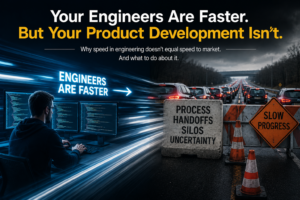

Last summer, MIT's NANDA initiative published a finding that should have rattled every boardroom that had just approved an AI budget: 95% of enterprise generative AI pilots were delivering no measurable impact on profit and loss. A year on, the tools are better, the spending is higher, and the gap the researchers named — the "GenAI Divide" — has only sharpened. Nowhere is it more visible than in how companies use AI in product development, where the distance between organizations that ship faster and better, and those merely running demos, is now measured in quarters of lost ground.The uncomfortable part of the MIT finding is what it ruled out. The failures were not mainly about model quality, regulation, or talent scarcity — the reasons executives most like to cite. The researchers pointed instead to a "learning gap": pilots stalled because the tools, and the organizations around them, couldn't retain feedback, adapt to real workflows, or improve over time. Generic assistants dazzled individuals and died in production. That is a management problem wearing a technology costume.
The divide is a discipline, not a tool
It is tempting to read the 5% as the companies that bought the best software. The evidence points the other way. MIT found that AI tools which integrate deeply into a specific workflow and adapt over time succeed roughly twice as often as generic ones — and that externally built or partnered tools outperformed internal moonshots. The winners were not distinguished by ambition. They were distinguished by where they aimed it.
In product organizations, that distinction is stark. The laggards treat AI as a productivity garnish: a summarizer bolted onto research calls, a first-draft generator for PRDs, a chatbot in the help center. Each is real, each saves a few minutes, and none of it shows up in the P&L, because none of it changes how decisions get made. The leaders are doing something structurally different. They are using AI to compress the loop between a customer signal and a shipped response — turning what used to be a staged, quarterly product lifecycle into something closer to a continuously running decision system.
The gains, where they appear, are concrete rather than magical. Teams are cutting sprint-planning and prioritization time by roughly a third to a half by letting AI synthesize the messy inputs — support tickets, sales-call notes, usage telemetry, competitive signals — that a PM used to reconcile by hand. Deloitte's 2026 enterprise research found that a majority of organizations now report tangible gains from AI, but the phrasing matters: tangible is doing a lot of work in that sentence, and it separates the firms measuring outcomes from those still admiring outputs.
What the 5% actually do
Three habits show up repeatedly among the organizations that cross the divide, and none of them require a frontier lab.First, they aim AI at the workflow, not the individual. The failed pilots optimized for a person drafting faster. The successful ones re-engineered a process — discovery, triage, prioritization — so that the AI sits inside the system of record and learns from every decision the team makes. MIT was explicit that success came from empowering line managers to drive adoption in their own workflows, not from a central AI lab issuing tools downward.
Second, they instrument the outcome before they scale the tool. If you cannot say what "better" looks like — cycle time from insight to release, defect escape rate, the share of roadmap items traceable to a validated customer problem — you cannot tell a genuine gain from a convincing demo. The 5% decide their metric first and let it kill the projects that don't move it.
Second only in importance is the third habit: they close the feedback loop deliberately. The learning gap MIT identified is fixable, but not by the model alone. It requires someone to own the discipline of feeding outcomes back in — labeling what shipped well, correcting what the system got wrong, retiring prompts and agents that have quietly drifted. The organizations that treat this as ongoing operational work, rather than a launch-day event, are the ones whose AI actually compounds.
Where the budget goes wrong
There is a quieter lesson in the data that product and technology leaders should sit with. MIT found that more than half of generative AI budgets flowed to sales and marketing tools, while the larger, more reliable returns were showing up in back-office and process automation — the unglamorous work of removing friction from how the organization already operates. Translated to product development, this is a warning against spending on the visible demo and starving the plumbing. The AI that reads every support ticket and reshapes your backlog will never trend on LinkedIn. It is also far more likely to change your numbers.
None of this argues for caution as a strategy. The 5% are not the timid firms; they are the disciplined ones, and they are pulling away. The reasonable posture for a technology-forward company that is not itself an AI vendor is neither to wait for the tooling to settle nor to greenlight a hundred pilots and hope. It is to pick one product workflow that genuinely bottlenecks your speed or quality, wire AI into it deeply enough to learn, decide in advance what result would justify scaling, and then be honest about whether you cleared the bar.
The GenAI Divide is not a prediction. It is already the shape of the market, and it is widening while the second-movers deliberate. A year from now, the question your board asks won't be whether you adopted AI in product development. It will be whether you were in the 5% that could prove it mattered.
More From Evio Group