There is a quiet, uncomfortable pattern showing up in enterprise product organizations this year. AI has made teams demonstrably faster — more pull requests merged, more features shipped, more experiments run — and yet the business results haven't moved the way the velocity charts promised. If you feel that tension inside your own product organization, you are not imagining it, and you are not alone.
The numbers tell the story plainly. Roughly 97% of executives report having deployed AI agents, but only about 29% see meaningful ROI, and Forrester found that just 15% of AI decision-makers could point to a positive impact on profitability over the past year. Nearly two-thirds of enterprises have experimented with AI in the build workflow; fewer than one in ten have scaled it into tangible value. This is no longer an adoption problem. Adoption is essentially solved. What remains is a translation problem — turning individual productivity into organizational outcomes.
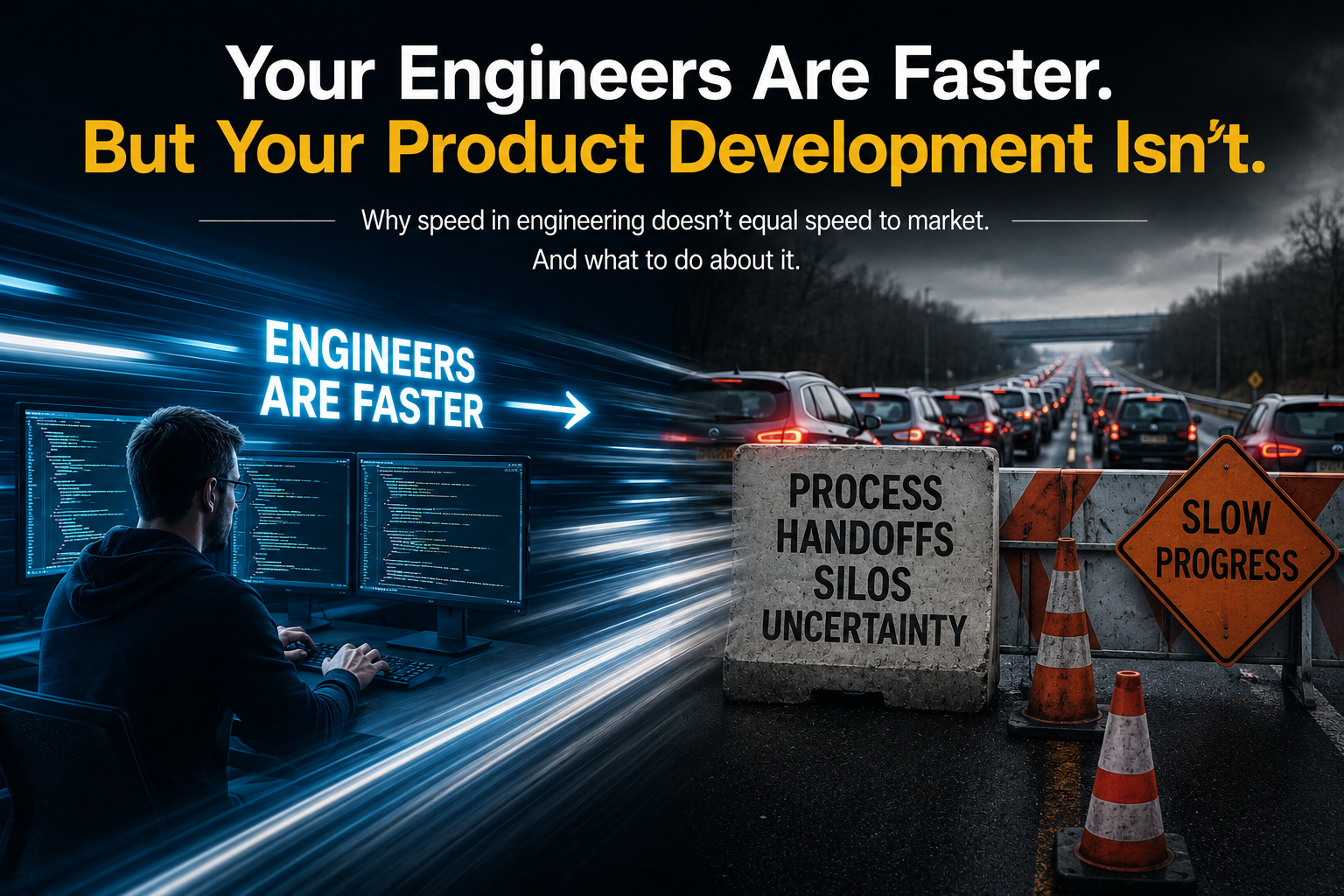
Here is the mechanism most leadership teams are missing. When you inject AI into the build phase, you speed up the part of the system that was rarely the true constraint. Engineers on high-AI-adoption teams complete more tasks and open more pull requests — but review time climbs, and the bottleneck simply slides downstream to human approval, integration, and judgment. You didn't remove the constraint. You relocated it. And in a lot of organizations, you relocated it to the single most important and least automated station on the line: the decision about what deserves to be built at all.
That is the real risk of this moment, and it deserves a blunt name. AI does not just help you build the right thing faster. It helps you build the wrong thing faster — with more polish, more conviction, and more sunk cost by the time anyone notices. A roadmap full of confidently executed, beautifully shipped features that customers didn't need is not a productivity win. It's an expensive way to be wrong at scale.
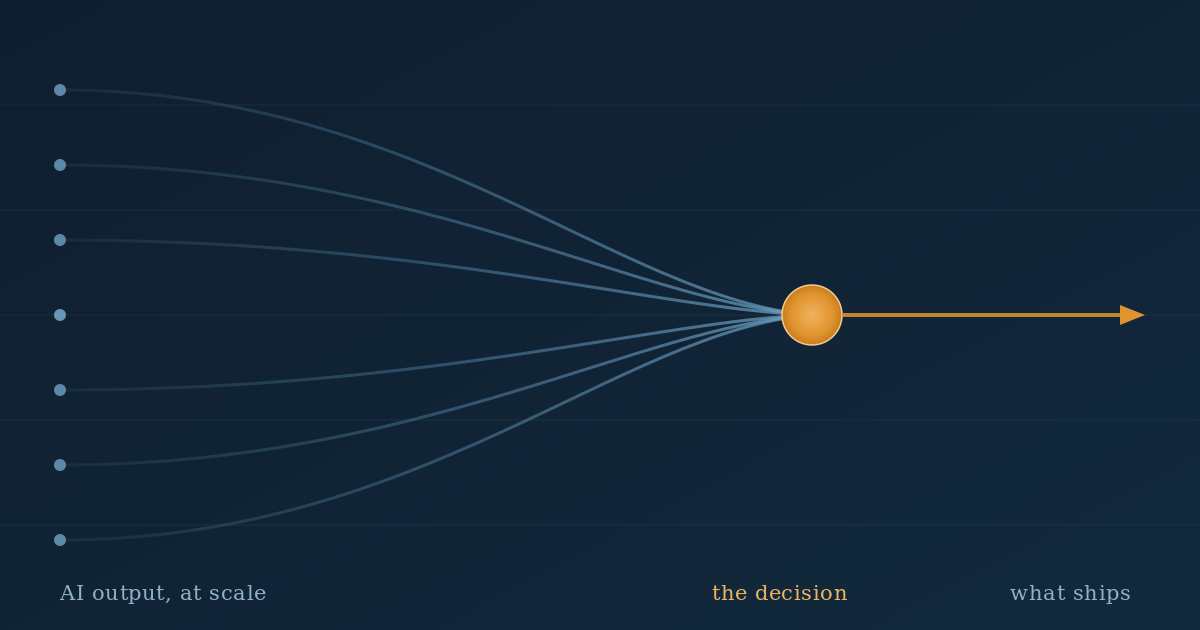
So what separates the organizations pulling ahead from the ones spinning their wheels? We've discussed the separation before (see: The Wrong 95%: Why Most AI Product Efforts Stall — and What the Rest Do Differently). It is not AI-assisted code share or weekly active usage of a copilot, though the leaders track those. The divergence is in where they aim the technology. Laggards point AI at output — writing code, generating tickets, drafting specs faster. Leaders point it at judgment — compressing the distance between a customer signal and a confident, well-reasoned decision.
Concretely, that looks like using AI where product managers have always been capacity-constrained: reading every support ticket, sales call, and review instead of a sampled handful; clustering thousands of raw signals into themes a human can actually adjudicate; pressure-testing a prioritization call by generating the strongest counterargument before a feature gets funded. The value isn't that a machine decides. It's that your best people arrive at the decision point already holding the full picture, faster, with the busywork stripped away. The scarce resource in product development was never typing speed. It was the quality and timeliness of decisions. That is the constraint worth spending AI on.
This reframing changes what you measure, and measurement is where intent becomes real. Commit counts and PR volume are activity metrics — they will happily light up green while value stays flat. The teams getting this right in 2026 pair velocity with quality guardrails and watch at least a few dimensions together: how much AI-assisted work actually ships, whether defect and rework rates hold as speed rises, and — most importantly — whether shipped work maps to a business outcome anyone can name. Higher velocity with rising rework is not progress. It's the sound of a team building the wrong thing more efficiently.
None of this requires a moratorium on AI in the build workflow. Speed still matters; faster iteration is a genuine advantage when it's pointed at the right target. The correction is one of sequence and emphasis. Before you invest another dollar in shipping faster, make sure you've invested in deciding better — because a faster build engine bolted to a weak decision process just gets you to the wrong destination sooner. Forrester now expects enterprises to defer roughly a quarter of planned 2026 AI spend into 2027; that is the market quietly repricing speed-for-its-own-sake and asking a harder question about value.
For executive teams, the action this quarter is narrower than the hype suggests and more demanding. Find the real constraint in your product system — not the one that's easy to automate, the one that actually gates value. In most organizations it now sits at the decision, not the build. Point your AI investment there. Then change your dashboards so they reward outcomes over output, and give your product leaders explicit permission to slow the machine down at the one gate where being right matters more than being fast.
The companies that win the next phase won't be the ones that shipped the most. They'll be the ones that used AI to be right more often — and had the discipline to tell the difference.
External Resources:
Product Impact — 97% deployed AI agents, only 29% see ROI
WRITER — Enterprise AI adoption 2026
Oobeya — Engineering metrics in the AI era 2026
MarketScale — Enterprise AI moves from pilot to production in 2026
More From Evio Group